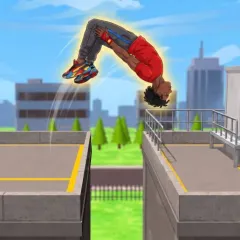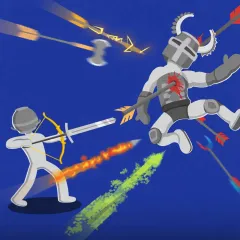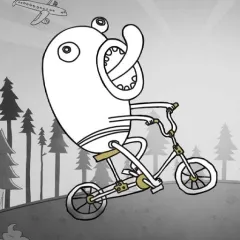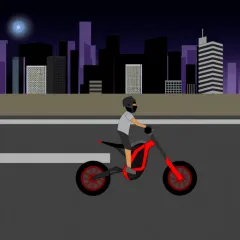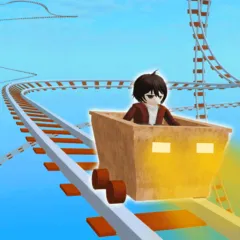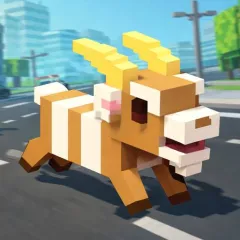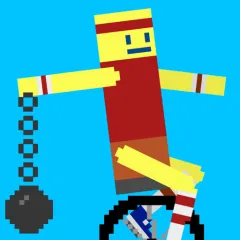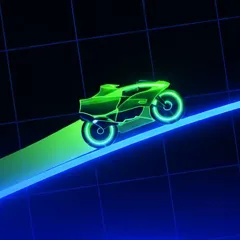
I tried Flip Spot for the first time one evening, thinking to myself, "I'll just kill time for five minutes and then turn it off." Unexpectedly, I sat there for almost an hour, telling myself, "This time I'll definitely land beautifully," only to fall flat on my face, laugh to myself, and press Replay again. That's the sweet trap of Flip Spot: a game that seems to have nothing much to say – just jump, spin, and land – but it's addictive in a way that's hard to explain.
Many extreme sports games give you a long race track with dozens of obstacles to overcome. Flip Spot, on the other hand, chooses to "condense" everything into a single moment: you stand on a high platform, jump, spin in mid-air, and then land. That's it. No track, no long combos, nothing to distract you from the single question: will I land beautifully this time?
Because everything hinges on a single jump, the tension increases rather than decreases. You don't have a chance to "recover points" in the next phase like in obstacle course games – a mistake is a mistake, and that makes each button press carry a certain weight, even if it only lasts a few seconds.
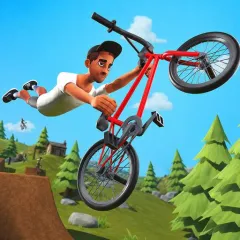
The beauty of Flip Spot lies in the fact that it doesn't need many buttons to create depth. You hold the button to build up power for the jump, release to bounce, then hold it again for the character to somersault in mid-air. That's it. But the more I play, the more I realize: that seemingly simple button is actually a psychological game.
Holding it for another half second gives you another spectacular somersault to show off. But holding it for another half second could also be the reason you land on your... face instead of your feet. The feeling of hesitation, "one more somersault or stop to be safe," is what makes Flip Spot so captivating. It doesn't penalize you for playing it safe, but it generously rewards those who dare to take risks at the right moment.
I noticed something quite interesting: my best landings weren't usually when I tried to do many somersaults to "show off," but when I calmly counted the rhythm in my head and released the button as soon as I felt the character's feet pointing downwards. It's like my body learned the rhythm of the game before my mind even realized it.
Don't think all jumps in Flip Spot are the same. Each platform, each landing distance, gives you a completely different amount of flight time, and that completely changes how you approach it. Some platforms are low, with flight times so short you only have enough time for a neat somersault before you have to release the button. But there are also towering platforms, giving you plenty of space to try taking risks with two or three consecutive spins.
My personal experience is: never judge a new platform by its appearance. The platform may not look very high, but the landing distance is far, making the flight time longer than expected. The only way to know for sure is to try it once, accept the possibility of falling, and then derive your own "formula" for that particular platform. In other words, Flip Spot doesn't teach you with theory; it teaches you through your falls.
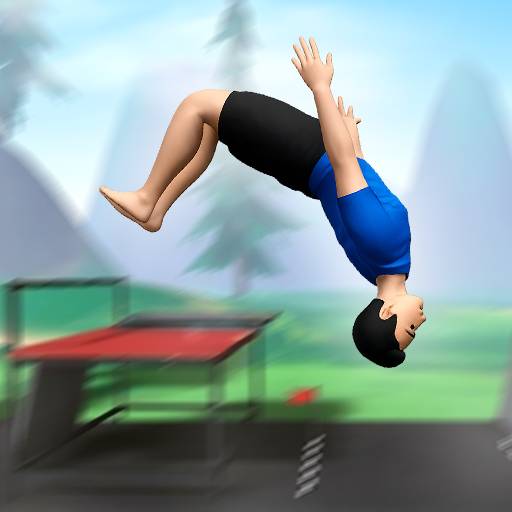
A small detail that greatly impacts the experience: when you fail, Flip Spot lets you replay almost immediately, with no loading screen or distracting effects. It sounds normal, but compare it to games that make you wait a few seconds for loading after each loss to see the difference.
The feeling of the failed timing is still fresh in your mind, and being able to try again immediately allows you to adjust while your memory of the previous jump remains intact. I often tell myself things like, "I released it a little too late, this time press it a bit earlier" – and it's this constant trial-error-correction loop, with almost no breaks, that makes you lose track of time while playing.
There are no extra buttons, no "help" buttons. All the pressure is on just one finger – and perhaps it's this extreme minimalism that makes Flip Spot unique.
Thinking about it, Flip Spot isn't anything spectacular: no storyline, no character upgrades, no fancy leaderboards. But perhaps that very "nothingness" is its strength. The game doesn't require you to memorize combos or learn complex mechanics; it only requires you to trust your instincts for a fraction of a second – and that's a feeling you can't necessarily master with a lot of practice.
If you're looking for a quick break from work, or simply want to challenge yourself with increasingly daring flips, Flip Spot is worth a few minutes. Just be careful, because those "few minutes" can easily turn into an entire evening without you even realizing it.